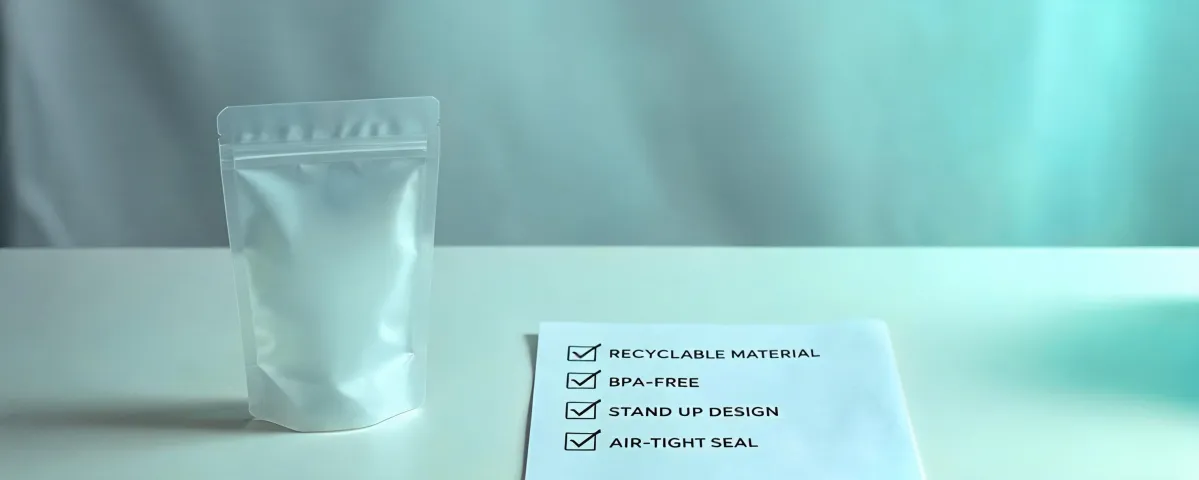
In February I approved a 60,000-piece order of what the supplier called "recyclable stand-up pouches." The quote was clean. The sample looked fine. Twenty-two days later our sustainability lead asked me one question I couldn't answer: recyclable where, and in which stream?
I didn't know. Nobody in that email chain had ever used the word "stream" — not me, not the trading company, not the broker who introduced us. I'd been buying packaging for four years by then and I still thought I was buying a material. I was actually buying a claim, and claims have paperwork attached.
The problem I thought I had
When we started sourcing recyclable stand-up pouches, my problem list looked like this: unit price per thousand, MOQ, lead time, print quality on the matte finish, and whether the supplier could hit our launch date. Standard procurement stuff. I put together an RFQ, sent it to six suppliers, built a comparison sheet, and picked the middle quote because the cheapest one had a suspiciously vague spec sheet.
That felt like diligence. It wasn't. I'd compared six quotes on a word none of them defined the same way.
It's tempting to think recyclable pouch sourcing is just regular pouch sourcing with a different material line on the spec. But the moment "recyclable" enters the conversation, you've added a regulatory layer, a disclosure layer, and an end-of-life layer that the factory can't resolve for you — because the factory doesn't know where your customers live or what your retailer's packaging questionnaire asks.
What the problem actually is
Here's the thing I wish someone had drawn on a whiteboard for me: "recyclable" is three separate questions collapsed into one word.
Question one: what is the structure?
Not "is it recyclable." The structure. Mono-material PE, mono-PP, a PE/EVOH laminate, metallized film, paper-backed with a PE liner — each behaves differently in a sorting facility. A pouch can be 90% polyethylene by weight and still fail a recyclability assessment because of the zipper resin, the valve, or a full-surface adhesive that doesn't separate.
Suppliers quote to the word. If you write "recyclable" on the RFQ, you'll get six different structures back and a price spread that looks like a market inefficiency. It isn't. You're comparing different products.
Question two: recyclable through what pathway?
Store drop-off, kerbside, industrial compost — these aren't interchangeable, and availability changes by postcode. A pouch that's genuinely recyclable in a region with a mature flexible-film collection program may have no practical pathway three states over. That's not the supplier lying. That's you not asking.
Question three: what can you legally print on it?
This is where it stops being a purchasing problem and becomes a legal one. In the U.S., the FTC's Green Guides govern environmental marketing claims:
Per the FTC's Green Guides (16 CFR Part 260), a "recyclable" claim should be qualified when recycling facilities are not available to a "substantial majority" of consumers where the product is sold. The Guides' own examples use 60% as the benchmark for that threshold. Source: ftc.gov, 16 CFR Part 260.
Read that again with your artwork in front of you. If you print a chasing-arrows symbol on a pouch that most of your customers can't actually recycle, the claim is the problem — not the film.
The causation most buyers get backwards
People assume recyclable pouches cost more because the material costs more. That's only partly true. In the quotes we collected across 2024 and early 2025, most of the premium came from inefficiency: shorter runs because fewer factories will commit to mono-material structures at low volume, tighter lamination tolerances, higher scrap rates during setup, and the labor of producing documentation nobody used to ask for.
Which means the premium shrinks as your volume grows and your spec stabilizes. It also means the "cheaper" quote is often cheaper because someone quietly substituted a structure that won't pass the assessment you never wrote.
Why the damage is locked in at the artwork stage
Here's the part that cost me the most, and it wasn't money.
The recyclability of a printed stand-up pouch is largely decided before the film is extruded. Ink coverage, adhesive choice, the zipper, the spout, the tear notch, whether the front panel is matte-laminated — every one of those is an artwork-stage or spec-stage decision, and several of them can quietly disqualify a pouch that started life as a perfectly good mono-material structure.
Once the cylinders are engraved and the film is printed, you're not editing a spec sheet anymore. You're paying for new plates.
The surprise wasn't the price difference between suppliers. It was how much of the total cost sat in decisions I'd made in a two-hour window because our launch date was fixed and the factory was closing for the holiday.
What it actually costs when you get it wrong
I'll use my own numbers, with the caveat that this is one company's experience and not a market benchmark.
- The reprint. Film is the expensive part of a pouch order, not the printing. Re-running 60,000 pouches because the structure changed set us back roughly the cost of the original order plus about 30% — and that was the discount version, printed on the same cylinders.
- The air freight. A sea shipment gave us a ten-week cushion. A reprint gave us three weeks. We paid to fly pouches. I'd rather not say what that line item looked like on the P&L.
- The internal credibility hit. I had to tell our founder that the packaging she'd already shown to two retail buyers was going back to the factory. That conversation took eleven minutes and I remember all of them.
- The retailer questionnaire. Two of our stockists now ask for packaging material disclosure at onboarding. I didn't have the documentation, so I asked the supplier, who asked their factory, who sent a spec sheet in a format that answered none of the questions.
And the slow-burn cost: several U.S. states are phasing in extended producer responsibility programs for packaging, and California's SB 54 sets a 2032 deadline for covered packaging to be recyclable or compostable. Every year you buy a structure you can't document is a year of inventory you may have to account for later.
What I do differently now — briefly
I'm not going to pretend this is a sophisticated system. It's five things, and the first one is the only one that really matters.
- Define the end-of-life pathway before the RFQ goes out. One sentence: "This pouch is intended for [pathway] in [markets], and we need documentation supporting that." If a supplier can't respond to that sentence, they're not a recyclable pouch supplier — they're a pouch supplier with a good line of copy.
- Ask for the structure in writing, by percentage. Material, adhesive, zipper resin, any barrier layer. If they won't put it in an email, that tells you something.
- Order a small run first, even at a bad unit price. Sixty thousand pouches is not a test. Two thousand is a test.
- Keep the claim off the artwork until you have the documentation. Print the structure-neutral version first if you can. You can always add a symbol in a later run. Removing one is a reprint.
- Say no to absolute language. I don't approve copy that says "100% recyclable" or "guaranteed food-safe" unless there's a certificate in the folder with a date on it. That's not caution, that's self-preservation.
The part that's genuinely changed
What was best practice in 2020 doesn't fully apply in 2025. Five years ago, mono-material stand-up pouches were commercially awkward for a lot of applications — the barrier performance wasn't there for anything oily or oxygen-sensitive, and the number of factories willing to run small orders was short enough to fit on one hand.
That's moved. There are more structures, more converters, and more buyers asking the question, which is usually what makes a category real.
But the fundamentals haven't changed: you can't buy a claim you can't document, and no factory is going to define your end-of-life pathway for you. That was true in 2020 and it'll be true in 2030.
The word on the quote isn't the product. The structure sheet is the product.
Pricing references reflect our own sourcing records from 2024–early 2025 and vary by structure, volume, and printer. Regulatory information is general guidance only — verify current requirements at ftc.gov and with your state's packaging stewardship program before printing any environmental claim.